
This time I won’t bury the lede: eight weeks ago, I had heart surgery. I wanted to have some perspective on the experience before writing about it. While my recuperation is by no means complete, I will write about where I am now, and how I got to this point.
In my thirties, my family physician told me that I had mitral valve prolapse. The mitral valve connects the left atrium to the left ventricle, and mitral valve prolapse means that the valve bulges into the atrium when the blood flows from the atrium into the ventricle. He told me it is relatively common and nothing to worry about. By my mid-twenties, aerobic sports (jogging, swimming, cycling, cross-country skiing) had become a daily necessity, and prolapse would not affect that. I kept active and carried on.
From Prolapse to Regurgitation
Mitral valve prolapse may lead to mitral valve regurgitation, which is a more serious condition. In regurgitation, the mitral valve doesn’t close completely, and some blood leaks back from the ventricle into the atrium. As a result, the heart must work harder to pump the blood a second time. Nonetheless, the heart can compensate for quite some time. But when the heart can no longer compensate, the patient has symptoms such as shortness of breath or an irregular heartbeat.
About ten years ago, my family physician thought he was hearing the backsplash of the blood by stethoscope and referred me to a cardiologist. The cardiologist sent me for an echocardiogram to investigate the family physician’s hunch. The echocardiogram confirmed that I had mild regurgitation. As time went on, the mild regurgitation escalated to moderate regurgitation and the cardiologist told me that, sooner or later, I would need surgery to repair the mitral valve. He monitored me with echocardiograms every six months. I continued with my aerobic fitness, but I was slowing down due to normal aging. A year ago, while jogging I had an episode of atrial fibrillation, a very rapid and irregular heartbeat. I went to the emergency room, and after an hour or two, my heartbeat returned to normal without medical intervention, as is usually the case. A few months later, I had another episode of atrial fibrillation. The cardiologist concluded that it was time for surgery, and he referred me to Dr. Gideon Cohen, the chief of cardiac surgery at Sunnybrook Health Sciences Centre.
Enter the Robot
While preparing to meet Dr. Cohen, I did some reading about mitral valve repair. The traditional approach to mitral valve repair involves breaking the sternum (sternotomy) to access the heart, leaving a scar that runs from the collarbone to the navel. An alternative approach, referred to as minimally invasive and available at some leading-edge hospitals in the U.S., involves using a robotic device to access the heart by making a small incision between the ribs, eliminating the need for a sternotomy. The minimally invasive approach involves less surgical trauma and a significantly shorter stay in hospital (four days rather than ten).
In my meeting with Dr. Cohen, I asked, if his father were in the same situation as me, would he recommend valve repair surgery. His answer was that valve repair surgery would lead to a longer life and better quality of life. I also asked about the minimally invasive approach. He told me that Sunnybrook would soon be acquiring the robotic device and that a young Canadian surgeon, Dr. Derrick Tam, would be returning to Canada from a fellowship in Los Angeles where he had performed some 200 surgeries using the robotic device. (In this context robotic is something of a misnomer, because the device is not programmed, rather it is operated remotely by the surgeon). Because I was not showing any shortness of breath (walking at the same distance and pace as before the atrial fibrillation), I didn’t need surgery urgently and could wait until both the device and Dr. Tam arrived at Sunnybrook. I met with Dr. Tam and opted for the minimally invasive approach in several months.
The system Sunnybrook acquired is a Da Vinci Xi, produced by Intuitive Surgical Systems, located in Silicon Valley (Sunnyvale, CA) and listed on the Nasdaq as ISRG. The Da Vinci can also be used for prostate, hernia, gastrointestinal, and hysterectomy surgery in addition to cardiac valve repair. The full cost over its seven-year lifespan – including purchase, maintenance, replacement parts, and software upgrades – is about $7 million USD. Sunnybrook funded the purchase independently, without assistance from the Ontario Ministry of Health.
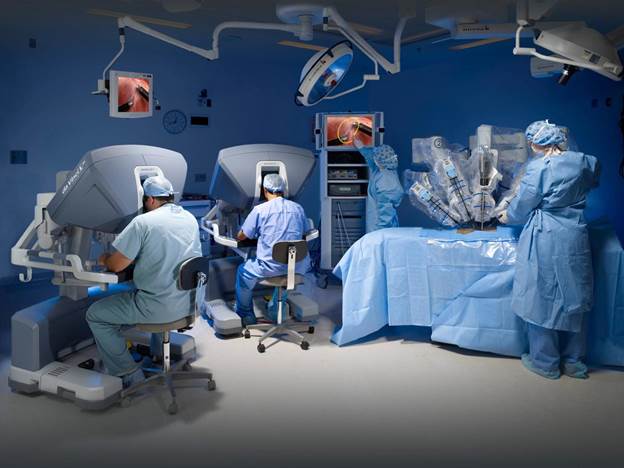
The illustration shows the robot’s four arms situated over the operating table, with two consoles for surgeons to observe the heart and operate the system. In my case, the surgical team consisted of Dr. Tam, who is very experienced with Da Vinci, and Dr. Cohen, who has 30 years of experience operating on heart valves. What an excellent team, combining two different types of expertise and experience to provide an effective and durable valve repair!
After the surgery, I spent one day in the cardiac intensive care unit, then was moved to a cardiac ward for three days, and after that I went home. My recuperation, which is gradual, has several aspects. As directed by Sunnybrook’s physiotherapy team, I am walking at a slow pace for increasing times, on level terrain. I’m now up to 45 minutes. Over the next few months, I hope to return to a brisk pace and over an hour. My energy level remains lower than pre-surgery, and I often take morning and afternoon naps, which I regard as a luxury. Finally, the incision was below my right pectoral muscle, and the pain in that area has lessened from pins-and-needles to a dull ache.
Policy Implications
Sunnybrook likes its first Da Vinci so much that it is fundraising for a second. This raises the question of whether the Ontario Ministry of Health should consider buying the Da Vinci device for numerous hospitals (of course with a volume discount). An investment analysis would weigh the cost of the device against the savings resulting from shorter hospital stays. A second benefit is that patients would have reduced surgical trauma, which isn’t measured in monetary terms by the Ontario health system. That said, it would be possible to use questionnaires to ask patients or even the general public what value they would put on shorter hospital stays and reduced trauma.
“Elbows up” has become a public policy meme in Canada. The Da Vinci is manufactured in the U.S. and Intuitive Surgical Systems has a near-monopoly. There are no current or potential future Canadian manufacturers. Assuming the Da Vinci passes the cost-benefit test, it would be in the interest of Canadian health ministries and patients to import more Da Vincis. I don’t think “elbows up” applies in this case.
The Trump Administration is skeptical about non-Americans doing jobs that Americans could do. In this case, it would mean an American holding the fellowship that Dr. Tam held. But foreign doctors trained in the U.S. are likely to be strong supporters of their home countries importing U.S. technology.
My conclusion is that, in medicine as in many other areas of the economy, free trade in technology and labour will benefit everyone. I deeply appreciate having my heart surgery made less traumatic by using a medical device developed in the U.S., purchased through Canadian fundraising, and operating by a team consisting of two excellent Canadian cardiac surgeons, one who trained on the Da Vinci system on a fellowship in the U.S.


Leave a Reply