
One of the best sartorial decisions I ever made was to spend $150, which seemed like a lot of money in 1977, to buy my doctoral robes: a Harvard Ph.D., with black velvet in front and on three stripes on each arm set against a background that is officially crimson, but looks to me more like cherry red.
Pretty in Pink
I’ve attended convocation almost every year, even when not holding academic leadership roles. Convocation is the only ceremony in a modern university, and my colourful robes make a fashion statement students and their parents enjoy. And I welcome the opportunity to congratulate students I know.
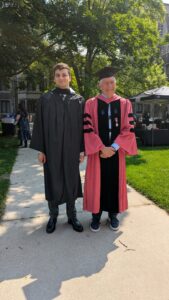
This year my son Nathaniel convocated at the University of Toronto, and I wanted to experience convocation in its entirety as a proud parent. My status as an emeritus faculty member enabled me to participate in the academic procession and see the ceremony from the stage, rather than from the audience.
Nathaniel’s convocation was with his college, Victoria. We arrived at Vic late in the morning for him to pick up his gown, and we joined the luncheon in the courtyard on a beautiful sunny day. Nathaniel had a chance to meet classmates, and I was delighted to hear that most of those he met, like him, were going to a graduate program. And I was pleasantly surprised to meet two former University of Toronto at Scarborough colleagues, Pankaj Aggarwal and Mark Schmuckler, also had children in the same convocation.
Convocation …
A convocation is a large meeting for a specific purpose, and in this instance, it is for the granting of degrees. The honorary degree recipient was the television and film director Alan Taylor, who had taken his undergraduate degree at Victoria College. Taylor’s message to graduates, illustrated with stories from his career as a director, was “life will not go as you intend … this is to be embraced. … Your best work happens when your plan hits reality.” Taylor also referred to the U.S. as “slouching towards oligarchy” and took it as a “spark of hope” that “academic institutions are reasserting their rights.” I completely agree with his advice and assessment.
In the last few years there have been two major changes to the University of Toronto’s convocations: they have become shorter and more egalitarian. Before the pandemic, degree recipients came onto the stage, knelt before the Chancellor, were hooded, and the Chancellor congratulated them. As this process crawled along, those who already received their degrees often took the diploma and ran. The pandemic ended this intense face-to-face contact; now degree recipients have their name called and cross the stage, which is much faster. Someone came up with a psychologically persuasive way of encouraging all degree recipients to stay to the end of the ceremony. At the outset, the President calls the name of the last person to receive a degree and asks them to stand and wave. Then the President asks the degree recipients to stay to the end as a matter of respect for that individual. It works.
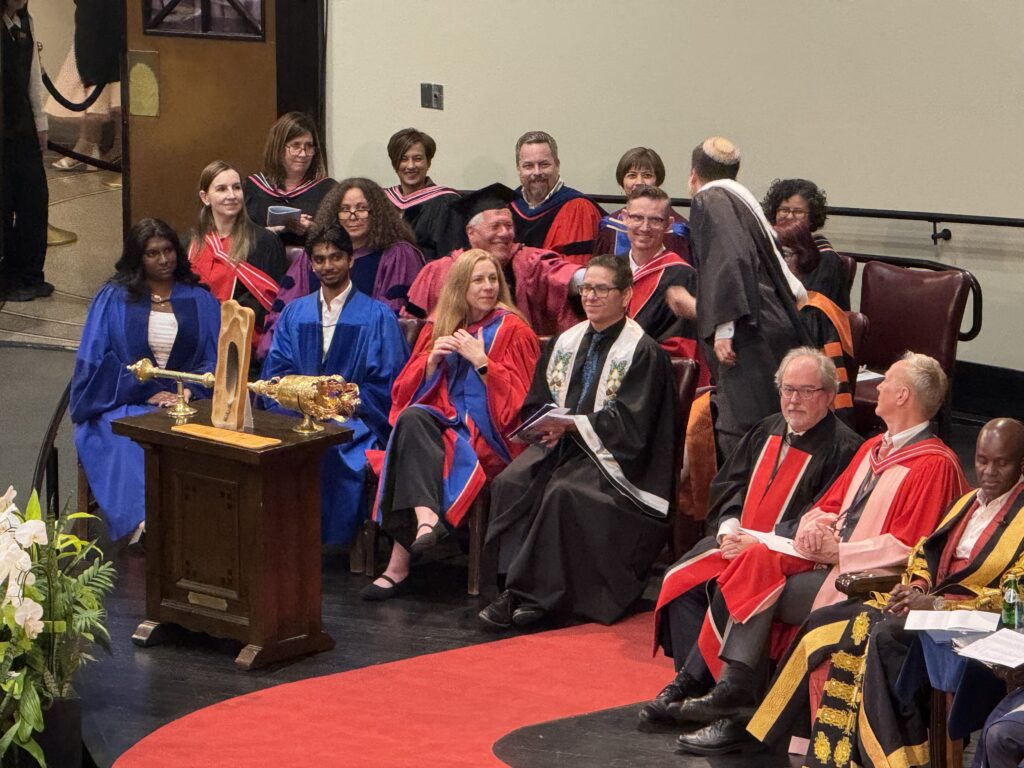
Our convocations have become more egalitarian in two ways. In the past, those who graduated with high distinction received their degrees first, followed by those who graduated with distinction, followed by the rest. Now all degree recipients are in the same pool, though the program still indicates those who received high distinction and distinction. In addition, the platform party was told not to embrace or stand for individual graduates, so that all graduates would be treated equally. I had intended to stand when my son Nathaniel was crossing the stage. It turned out that I was sitting three seats from the aisle that students took as they left the stage, so I was able to fist-bump with Nathaniel from my seat, thus obeying orders. Our friend Chandran Mylvaganam captured the moment.
After all degrees are conferred the ceremony ends with the singing of “O Canada,” which struck me as particular resonant because of the Trump Administration’s verbal assault on Canadian sovereignty and financial attack on American universities. I would like to think that the singing of the national anthem at convocation speaks to mutual respect and common purpose between our governments and our universities.
The academic procession left Convocation Hall with the organist playing as a recessional the lively and inspiring toccata from Charles-Marie Widor’s fifth organ symphony. If you think you’ve never heard it before, please listen to it now – it will brighten your day. Though Widor was a prolific composer and organist of the late nineteenth and early twentieth centuries, this piece was his one major hit (like Johann Pachelbel’s Canon).
… Or Commencement
Though the University of Toronto refers to this event as Convocation, my alma mater calls it Commencement. Indeed, it represents both an achievement and the beginning of adulthood. Watching several hundred young people cross the stage brought to mind Erik Erikson’s model of the human life cycle. If all goes well, graduates emerge from their undergraduate years with a clear sense of their identity and go on to find rewarding careers and compatible life partners. I was also thinking of news stories about the troubling impact of AI and of the economic uncertainty created by trade wars on the labour markets that these young people will be entering. At Convocation for the first time as a parent, I had a deep feeling of empathy with other parents, as we all thought about our hopes and fears for our children. Emerging from Convocation Hall into bright sunshine symbolized the future we all want for our beloved children.

Leave a Reply