
The third time I encountered Auschwitz was at the exhibition Auschwitz. Not Long Ago. Not Far Away that opened at the Royal Ontario Museum on January 10 and that will be there until September 1. It was developed by the Spanish exhibition producers Musealia, using a variety of sources, most notably the Auschwitz-Birkenau State Museum.
The exhibit employs documentation, artifacts, and narration to tell the story of the rise of Naziism, Nazi racial ideology, the decision to make a final solution to the “Jewish problem” and to implement it through industrial-scale murder of Jews and other “sub-humans” at the Auschwitz-Birkenau concentration camp. The story ends with the attempt by the Nazi regime to destroy the evidence of its actions, and the liberation of the camp.
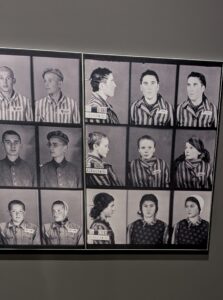
The artifacts – a soup cauldron, a prison uniform, part of a barracks, mugshots of prisoners in the early days of the camp, a woman’s shoe, camp commander Rudolf Hoss’s desk, Josef Mengele’s leather boots, a shower head – frame the narrative and give it a chilling reality. In addition to written documentation and drawings by survivors, the exhibition uses acoustiguide technology (which I much prefer to synching my phone with a website) to add the personal experience of survivors, who are shown speaking on video screens. There are 30 acoustiguide stations, so if you listen to them all, as I did, it is a long exhibit.
The exhibit does not include the most grisly images associated with the concentration camp, such as the piles of corpses and emaciated prisoners seen when the camp was liberated. But death is present in other ways. Several of the survivors talk of stench of fear and death that was around them and that they would remember for the rest of their lives. There were numerous pictures of people whose murder was imminent, including mugshots of prisoners and a mother and her children who were shot moments later.
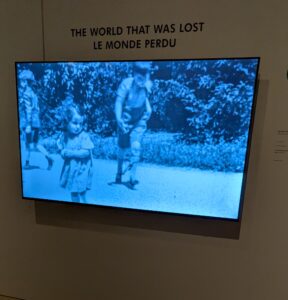
The last set of images is three minutes of clips from home movies made by European Jews before the Holocaust. These were not pious shtetl-dwellers, but secular German, Hungarian, Czech, and Danish Jews going to school, having picnics, enjoying themselves at the beach, and participating in a Zionist youth movement rally. The image that particularly hit home was of a Danish family celebrating Havdalah, because I knew we would be doing that a few hours later. The daily life of European Jews – destroyed. The final commentary observed that the Nazis had, in great measure, succeeded, because even now there are few Jews living in the areas of Europe they controlled.
The Evidence Room
My second encounter with Auschwitz, which I posted about, was at the ROM’s much smaller 2017 exhibit The Evidence Room, which is a representation of the evidence displayed at the libel trial in 2000 of Deborah Lipstadt, who had been sued by Holocaust denier David Irving. Lipstadt and her team had the burden of having to prove the existence of the gas chambers and crematoria at Auschwitz. The exhibit includes scale models, photographs, and documents such as architectural drawings. They were rendered in raised white plaster on a white background. The white-on-white suggests forensic reconstruction, white-washing, and the symbolism of death in many cultures.
The Concentration Camp Itself
My earliest encounter was Auschwitz itself, which I visited in 1997. It wasn’t crowded on that humid and stormy summer day. There were large display cases of shoes, suitcases, eyeglasses, children’s clothing, and human hair. In the Auschwitz part were the rough wooden barracks and in the Birkenau part concrete rubble from the gas chambers and crematoria.
Reasons for Hope
In all three of these encounters, I emerged with a measure of hope that mitigated my despair.
The point of The Evidence Room was that, despite the attempt of the Nazis to hide what they were doing and then what they had done, it was possible to use the testimony of survivors as well as architectural drawings (the latter in large measure the research of University of Waterloo Professor Robert Jan van Pelt) to establish beyond the shadow of a doubt the nature and extent of the crimes. For once, truth-telling prevailed over lies.
I was visiting Auschwitz with two non-Jewish academic colleagues. I desperately wanted to say Kaddish but needed a minyan. Just then a Jewish student group arrived, and I said Kaddish with them. We also sang Hatikvah. Standing with the second generation of Jews born after the Holocaust to bear witness to Jewish identity was an affirmation of the failure of the Nazi project.
On the second day of Auschwitz. Not Long Ago. Not Far Away. I wondered what sort of crowd, if any, I would see. It was a reasonably large and diverse crowd. People were silent and not making eye contact with one another. However, they were learning. The Holocaust will be neither denied not forgotten.

Leave a Reply