
When I taught courses on narrative and management, I always had a section on personal narratives. I used as its framework Erik Erikson’s famous eight stage model of the human life cycle. I like it because it is a normative model, with a clear view of what it means to live a valuable and meaningful life and what it means to fail.
Erikson in my Classroom
Erikson’s view of what gives meaning to life is found in the seventh and longest stage, or middle adulthood, which poses a dichotomy between generativity and stagnation. Generativity means doing things that benefit other people. I found the concept of generativity particularly useful when teaching management students, who would come into class influenced by a culture that encourages striving for wealth, power, and status.
The dichotomies I emphasized for my students were adolescence (identity versus role confusion), early adulthood (intimacy versus isolation), middle adulthood (generativity versus stagnation), and late adulthood (integrity versus despair). I asked students to write about themselves by discussing how well they were doing in terms of the first two dichotomies, and perhaps about how well their parents and grandparents were doing in terms of the latter two.
Erikson through his Daughter’s Eyes
In my teaching, I used Erikson’s theory as a tool, and I was more interested in the tool than the toolmaker. In retirement, I try to take the time to satisfy my curiosity. When a colleague mentioned that Erikson’s daughter Sue Erikson Bloland published a book in 2005 about the Erikson family, I immediately read it. The title, In the Shadow of Fame: A Memoir by the Daughter of Erik Erikson, is completely accurate. Bloland focuses on the fame Erikson gained as the public intellectual face of Freudian psychology, how his fame affected the dynamics of their family, and how it affected her. Bloland has made her own intellectual mark in studing the psychology of the pursuit and consequences of fame, both for the achiever and for their family. The book is revealing in its discussion of the Erikson family and of Bloland’s own life and is thought-provoking in its discussion of fame.
In this blog post, I will confine my attention to the narrower question of what she reveals about her father, and how he measured up in terms of his own theory. I regret that I’m not discussing her book at greater length, but I strongly recommend it.
A Struggle for Identity
Erik was born in 1902, out of wedlock, to a German Jewish woman. Erik’s father was a Danish Christian. His mother soon married a Jewish doctor, Theodor Homberger. Erik and his stepfather didn’t get along, in part because of a clash in values – the stepfather bourgeois and the stepson intellectual and bohemian – and in part because of their physical differences – the father short and dark and the son tall, fair, and blue-eyed. Erik’s mother was unwilling or unable to reveal anything about his birth father and Erik imagined that he was Danish nobility. Ultimately, Erik rejected his father and his father’s religion, and chose the surname Erikson, in effect telling the world that he was his own father.
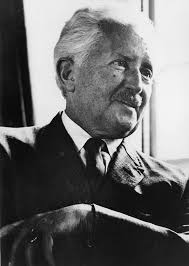
What impressed me about this story is that a person who had so primal and so unusual a search for his own identity would be drawn to the study of the search for identity and would make the idea of identity so central to his understanding of human psychology.
A Family Revolving Around a Star
Bloland makes clear that, as Erikson’s fame as a writer and public intellectual grew in the 1950s, the family revolved around him. (“Dad’s achievements had become the very cornerstone of his and Mother’s sense of well-being and feeling of self-worth,” pp. 92-3.) Erikson’s wife Joan, herself a highly intelligent and accomplished woman, helped Erik with his writing (as his mother tongue was German) and took full responsibility for running a household of three children. The children were sent away to boarding school, though Sue would have preferred to remain at home. The Eriksons had a fourth child, identified at birth as having Down’s Syndrome. He was immediately institutionalized, effectively removed from the family for the rest of his life. (Though this seems cruel and unnatural, it is likely that many families now, when told from an amniocentesis that a child would have Down’s Syndrome, would choose to abort the fetus. I recall that my wife and I discussing this eventuality and reached this conclusion.)
Erikson’s Regrets
Bloland describes her father’s last years as characterized by emotional and cognitive withdrawal, first from his work, and then from ordinary conversation and interaction with people (but not due to Alzheimer’s disease). And she suggests that, despite his achievements, Erikson’s own late adulthood had some of the markers of despair, rather than integrity.
Erikson appears to have been a workaholic, and when his ability to work – to continue to do leading-edge research and writing – diminished, there was nothing to take its place. Erikson and his wife were concerned that his writings would be forgotten, particularly among Freudian psychoanalysts – his initial professional peer-group – and among the broader community of psychologists. I wonder whether he had regrets about keeping his children, particularly the son with Down’s Syndrome, at a distance.
Google’s Verdict
Erikson died in 1994, at the dawn of the Internet age. Two Google products developed in the decade after his death shed light on his enduring influence.
Erikson’s Google scholar count is currently 252,650, which is off the charts. As a comparator, Elinor Ostrom, a wide-ranging social scientist who won the Nobel Prize for Economic Science in 2009, has a count of 261,380. Erikson is thus in very august company. You can look up Google scholar counts by year from 1985, which was when Erikson’s literary output ended. Erikson’s Google Scholar count peaked at 10,000 in 2013 and is over 5000 this year.
I also looked up “identity crisis,” one of Erikson’s major theoretical contributions, and a phrase he coined, on Google N-grams. It takes off in the late 1950s, and has stayed in currency since then, with its frequency plateauing rather than falling.
Jewish tradition says that a person dies three times: physical death, when there are no longer immediate family members to say Kaddish for them, and the last time their name is spoken. Erik Erikson is still very much alive.

Leave a Reply