
In her recent book Crossing: From US to Canada, Walking Roxham Road, the distinguished Canadian documentary photographer Ruth Kaplan refers to the scene at that irregular border crossing as theater. The space around the border is a kind of stage where asylum-seekers coming to Canada, the taxi drivers bringing them, the volunteers supporting them, the RCMP arresting them, and even observers like Ms. Kaplan documenting them are playing their roles. In 117 photographs and several texts, Crossing sympathetically explores the activity unfolding there.
Having enjoyed the benefits of academic tenure, I have great admiration for artists who are afforded much less financial stability in the pursuit of their muse, who must cobble together grants, teaching gigs, contract work, and crowdfunding. Ms. Kaplan, who is a friend, approached me to participate in crowdfunding her book.
I gladly contributed and a few weeks ago received an advance copy. Crossing is published only in hardcover by the German art and photography imprint Kehrer Verlag. It is available for $77 CDN on her website. (It is also available at Amazon, but you will provide more support for her if you buy it on her website.) While I do most of my reading using the Kindle app, I’m glad that a book highlighting photographs will be available only as a physical artefact.
Humanist Photography
Crossing is a work in the genre of humanist photography, as it chronicles people, most of them of colour, who are preparing to cross the US-Canada border at an irregular crossing point and then subject themselves to arrest in Canada as a first step toward seeking asylum. Many of the photographs locate people in the centre of the frame, surrounded by the dramatically changing seasonal scenery of rural upstate New York and Quebec’s Eastern Townships.
I am reproducing three of Ruth Ms. photographs to provide a sense of her work and her subjects.
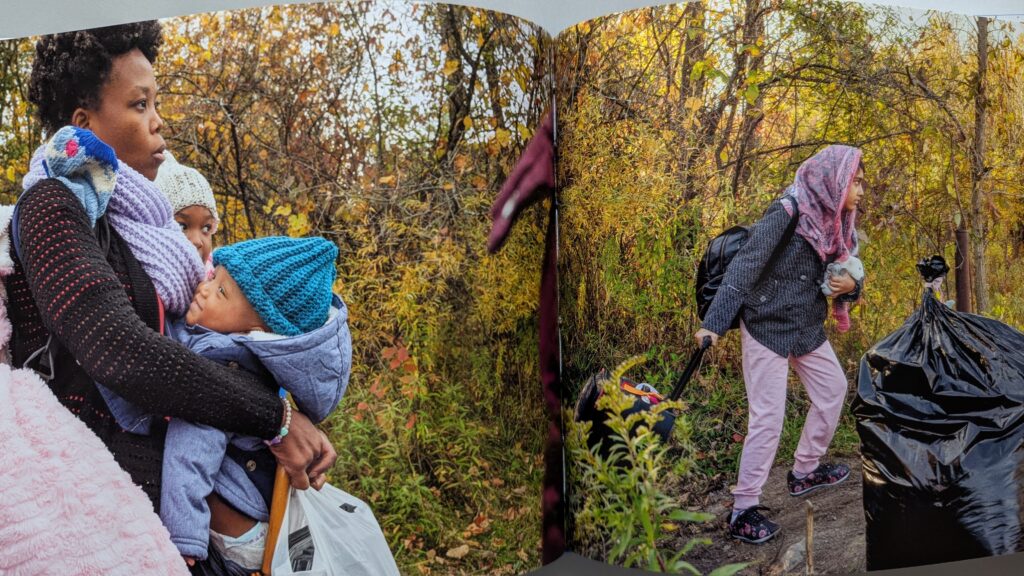
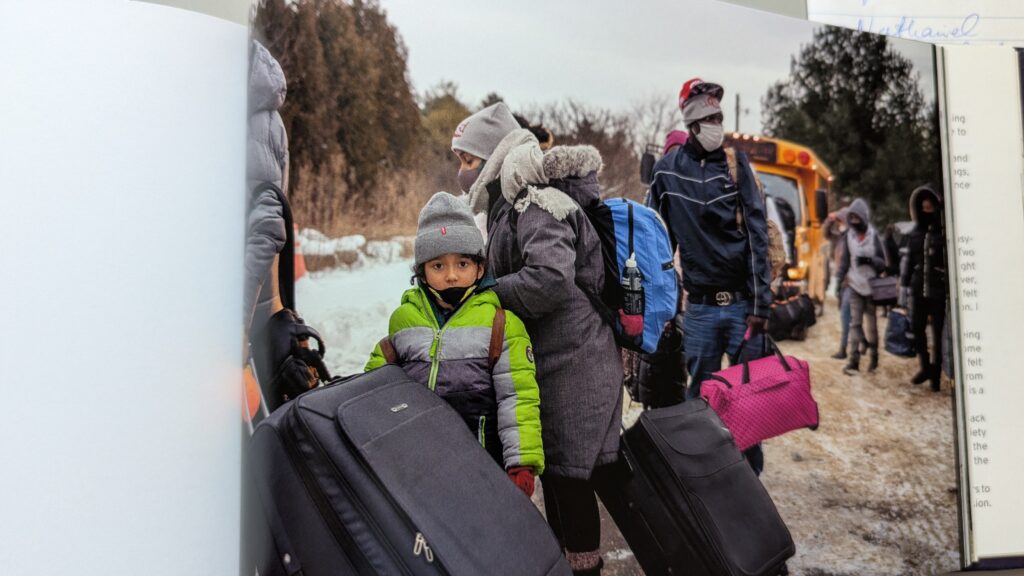
Though most of the book consists of Ms. Kaplan’s photos, it includes several texts. In one, Habib Zahori, an Afghan journalist, explores his emotions crossing the border from rural Maine to New Brunswick. Paradoxically, he begins to feel a sense of freedom as he is being arrested.
Ms. Kaplan tells us the book was eight years in the making. She began visiting Roxham Road in 2018, when the number of asylum-seekers began increasing in response to policies of the first Trump Administration. She made a dozen visits in subsequent years to both sides of the border. As a social scientist who thinks about research methodology, I can deduce from the finished product that Ms. Kaplan dealt successfully with the challenges of her inquiry. An irregular border crossing isn’t an easy place to get to, or to stay at. And she was able to persuade people in an extreme situation to co-operate with her.
In her own essay, Ms. Kaplan tells the reader that “the elders I grew up around, including my parents, made a home in Canada after fleeing Eastern Europe and the Holocaust” and that this explains the “familiarity” she felt with asylum-seekers.
The Memory of Roxham Road
In 2017, the first year of the first Trump Administration, 18,000 people crossed the border at Roxham Road. With the pandemic as a hiatus, the trend continued through the Biden Administration and 40,000 people crossed in 2022. At that point, the Trudeau Government and Biden Administration agreed to change the Safe Third Country Agreement to end irregular border crossing. The federal and Quebec governments concluded that handling so many asylum-seekers was administratively and logistically unsustainable. Public opinion was turning against what was perceived as people circumventing the refugee system.
Immigration is an essential part of Canadian history and remains a controversial policy issue. The treatment of refugees is an important aspect of immigration history and policy. There have been instances when public opinion has been receptive to refugees (the Vietnamese boat people in 1979-80) and times it hasn’t been (Jews fleeing Eastern Europe before and during World War II).
Irregular border crossing at Roxham Road no longer happens. Ms. Kaplan visited the site after 2023 and reports that it appears as though no movement of people ever happened there. Ms. Kaplan’s book is therefore an essential document in preserving the memory of this episode in our history, and I encourage you to read it. For me, it raises the question Beth Herst and I deal with in our own writing about public sphere narrative, namely the role art can play in understanding complex and urgent policy issues.
Leave a Reply