
Both my health card and driver’s licence needed to be renewed, and because the photo on both is more than 10 years old, I could not do it online. I had to visit a Service Ontario office. The closest one, five kilometres from my home, happens to be located in a Staples store. The impact of this co-location, a recent service delivery experiment by the Ford Government, is the theme of this post.
Starting with Images
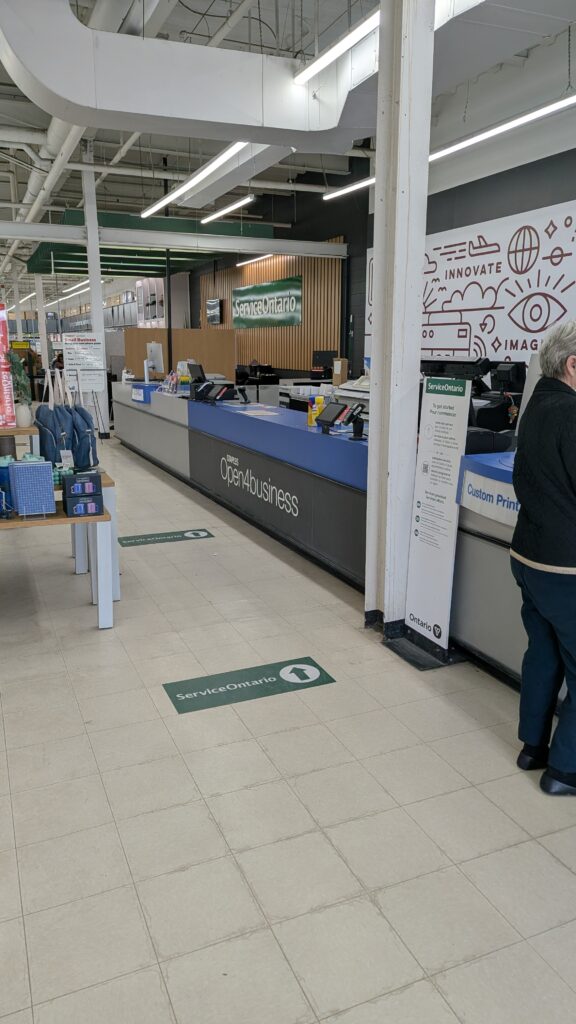
I’ll start with two photos to set the scene. The Service Ontario outlet is towards the back of the store, between the aisles of merchandise at the front and Staples’ own service centre at the back. The photo makes clear that the Service Ontario outlet is not walled off from the rest of the store.
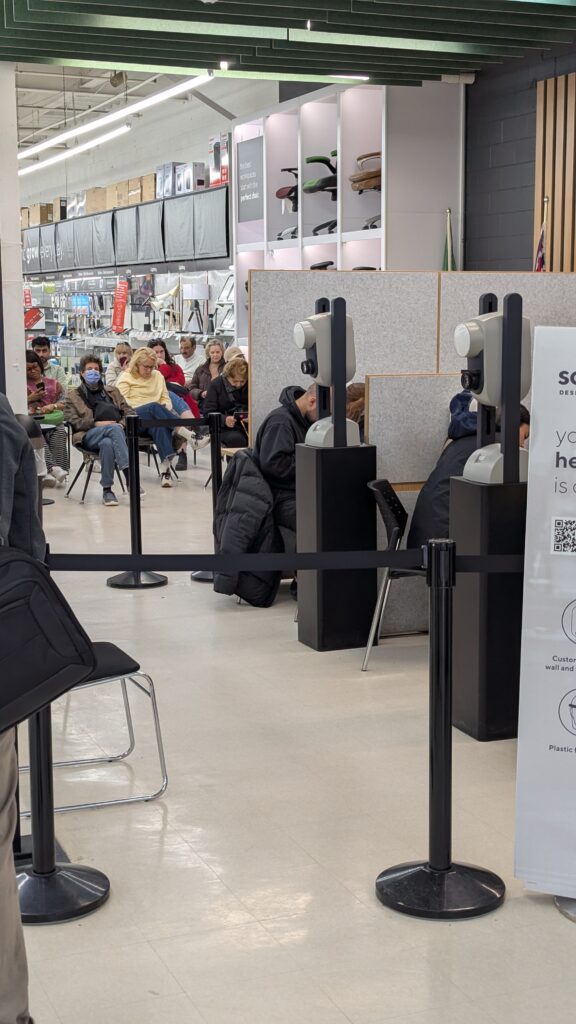
Beside the Service Ontario desks there is a small waiting area, right beside the aisles. And the photo also makes clear that there are quite a few people waiting.
I Hate to Wait
You can arrange an appointment online, or come as a walk-in. I hate waiting, so I made the first available appointment at that store, four weeks from the day of booking, at 11 a.m. on a Monday. To the credit of the staff, I was called exactly at 11 a.m. However, there was a queue of 10 clients for walk-ins. It seemed to me that each client took about 5 minutes, so walk-ins were waiting close to an hour. The conclusion is clear. If you value your time and if you can schedule your appointment a few weeks in advance you should make an appointment.
Assessing a Service Delivery Innovation
The part of the transaction mentioned in my title takes us to the heart of the service delivery innovation represented by co-locating Service Ontario at Staples stores. While the Service Ontario agent was examining my proof of identity, I noticed a $5 Staples coupon on her desk. I obliquely asked her about it and she quickly replied, “here, it’s for you, a $5 discount if you spend more than $20 today.” There was nothing I wanted to buy, so I didn’t use it.
Before doing research on narrative, I studied public sector innovation, so I started to think about my transaction in that context. I asked ChatGPT’s help, so what follows is based on information it provided and my reflections.
There are 275 Service Ontario centres, 30 percent of which are publicly operated and 70 percent of which are privately operated contracted storefronts. The Ford Government’s experiment is that it closed nine storefronts, chose Staples as a strategic partner – without any competition – and opened nine Service Ontario centres in Staples stores. The government pays the storefront operators on a per-transaction basis, whereas it pays Staples setup costs, labour, and an operating overhead. The employees at the publicly operated centres are public servants, the employees at storefronts work for the owner, and the employees at the Service Ontario centres at Staples work for Staples.
The first step in assessing whether co-location with a strategic partner is preferable to publicly-operated or storefront centres is to identify the relevant stakeholders and their interests.
Clients want to be dealt with expeditiously, accurately, and fairly.
Taxpayers want to know that the work is being done efficiently and accurately. Accuracy is probably the more important value. It is said that driving is a privilege, not a right. Health care is a right if you are a citizen or permanent resident. Taxpayers want to be sure that health cards and drivers’ licenses go only to people who are entitled to them.
Employees want fair wages, good working conditions, adequate training, and variety in their work experience. Working for Staples at the Service Ontario counter and various other roles provides greater variety than working for a Service Ontario storefront.
Staples sees the co-location of Service Ontario centres as an opportunity to bring more potential customers into the store, as the use of coupons indicates. In addition, if clients are waiting in line for an hour, the likelihood of impulse purchases increases. I asked ChatGPT about the economics of co-locating with Staples and it concluded that, assuming only half the coupons result in a purchase, nevertheless half of the net revenue (profit) for Staples will be from the government contract and half from the retail spillover. This is a very strong incentive for Staples to want Service Ontario centres in its stores.
That the Ford Government chose Staples for this strategic partnership without any competition is very troubling. Staples is not the only retail chain operating in the province. If other retail chains were allowed to compete, the ultimate winner might offer more favourable terms to the Government.
There is an additional, yet more troubling consideration. Though Ontario law does not permit direct corporate donations to political parties, retail chains bidding for the Service Ontario franchise might offer financial support to the Ontario PC Party through other channels, for example corporate tables at PC Party events and/or donations by their senior executives. Political support, of course, should not be part – the hidden part – of any bid to establish a strategic partnership.
More Study Needed
As readers of this blog know, I have almost always been critical of Ford Government decisions, for example moving the Science Centre, building a spa at Ontario Place, expanding Toronto Island Airport, building more highways, slowing the adoption of renewable energy, and often using the Notwithstanding Clause in the constitution. My reaction to the experiment of co-locating Service Ontario at Staples is not immediately critical. Though being handed a coupon seemed inappropriate, I received timely and professional service.
More study is needed to assess this new form of service delivery compared with the existing forms. That said, if the Government wants to change to widespread co-location of Service Ontario with a retail chain, the partnership should be open to bidding, not sole-sourced. And, if it is open to bidding, the choice should be removed from the purview of the politicians, to ensure that political support isn’t part of the package.


Leave a Reply