
I went to the Art Gallery of Ontario last weekend to see two exhibits. One captures a young artist encountering sudden global fame. The other makes the case for recognition of an artist whose work has been neglected for decades. I’m referring to the two recently opened exhibits at the Art Gallery of Ontario about the Beatles’ Paul McCartney and the musician and artist Edna Tacon (with a cedilla, thus pronounced Tasson).
Two Years in the Life
“Paul McCartney Photographs 1963-64: Eyes of the Storm” will be at the AGO until June 7 this year, after showings at the National Portrait Gallery in London (the original organizer) and in the US (Norfolk, Va., Brooklyn, Portland, San Francisco, and Nashville) and Japan (Tokyo, Osaka). Photography was one of McCartney’s passions and he used his Pentax 35 millimetre camera to chronicle his experiences. The exhibit includes 250 photos McCartney took in 1963 and 1964, the crucial period when the Beatles went from a British sensation to a global phenomenon. This period includes their first performances on the Ed Sullivan show and first North American tour.
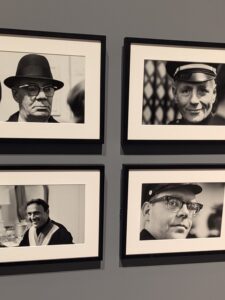
McCartney photographed his fellow Beatles, their managers and crew, their families, acts appearing with them, and their fans. The exhibit suggests that McCartney used his camera as a means of – literally – achieving perspective on the whirlwind engulfing him. McCartney is generous in his attention to the band and the fans who adulate them. The photos are candid and have an aspect of humour – as the group tries to enjoy the frenzy that surrounds them – and gratitude towards supporters and fans. Here are four photos of smiling middle-aged male fans from the U.S. tour.
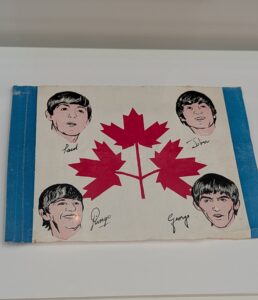
The AGO’s exhibit also includes photos and artefacts from the Beatles’ first Canadian appearance, in Toronto in September 1964. At a time when Canadians were debating the adoption of a new flag, someone came up with a version that incorporated the Fab Four.
The AGO is rolling out the exhibit in stages, with member’s access in the first week, access by members and annual passholders until March 22, and public access after that. There was a considerable crowd on the Sunday morning we went, and I could catch the buzz of people remembering how they were part of, or at least reacted to, Beatlemania, and younger people trying to learn about Beatlemania. I expect that, when the exhibit opens to the general public, crowds will be much bigger.
It it is easy to lose sight of the fact that President Kennedy was assassinated on November 22, 1963, right in the middle of Beatlemania. I think the assassination may have amplified Beatlemania, particularly in the U.S. The shocking and terrifying loss of one hero may have led people to look for other heroes, and it happened that these other four heroes were waiting in the wings.
Verve and Decorum
The McCartney exhibit takes up the entire fifth floor. “Verve and Decorum: The Non-Objective Art of Edna Tacon” occupies two rooms beside the elevators. Edna Tacon (1905-1980) created non-objective (or what is now referred to as abstract) art, working and exhibiting in both Toronto and New York. I found Tacon’s paintings colourful, eye-catching, and appealing. Her early work shows the influence of Wassily Kandinsky, but her later work is less rectilinear and has swirling images that remind me of Georgia O’Keeffe or perhaps the later work of Lawren Harris.
Renee van der Avoird, the AGO’s Associate Curator for Canadian Art curated the exhibit and wrote a book that is both a catalogue and the first comprehensive study of Tacon’s life and work. (Personal disclosure: When I was donating to the AGO the collection of Inuit art my mother gave me, Renee handled that complicated process with professionalism and understanding that I greatly appreciated.)
Tacon studied music from an early age, and worked professionally as a musician, playing the violin. There was clearly a relationship between Tacon’s music and her art. Van der Avoird (2026, p. 26) writes that “Tacon likened visual rhythms through space that appeal to the eye with aural rhythms in time that appeal to the ear. Rendered with a remarkable painterliness, the sinuous lines and richly worked backgrounds in these paintings are still concerned with the potential visuality of sound.”
Tacon did not have an easy life. She was adopted at age six after the death of her father. She married Paul Tacon, who was also an artist. There may have been an aspect of professional rivalry in the marriage, especially because she was more successful. He became abusive, and she fled the family home in Toronto for the avant garde artistic community based at the Guggenheim Museum in New York. Paul demanded custody of their two children in Toronto, denying her access to them. She had to work at a variety of jobs to support her art. And she faced the barriers to professional standing that many other creative women experienced in the Forties and Fifties.
Though most of the paintings in the exhibit are abstract, it does include a self-portrait, painted in 1955 at the age of 50, which I interpret as a creative telling of her story.
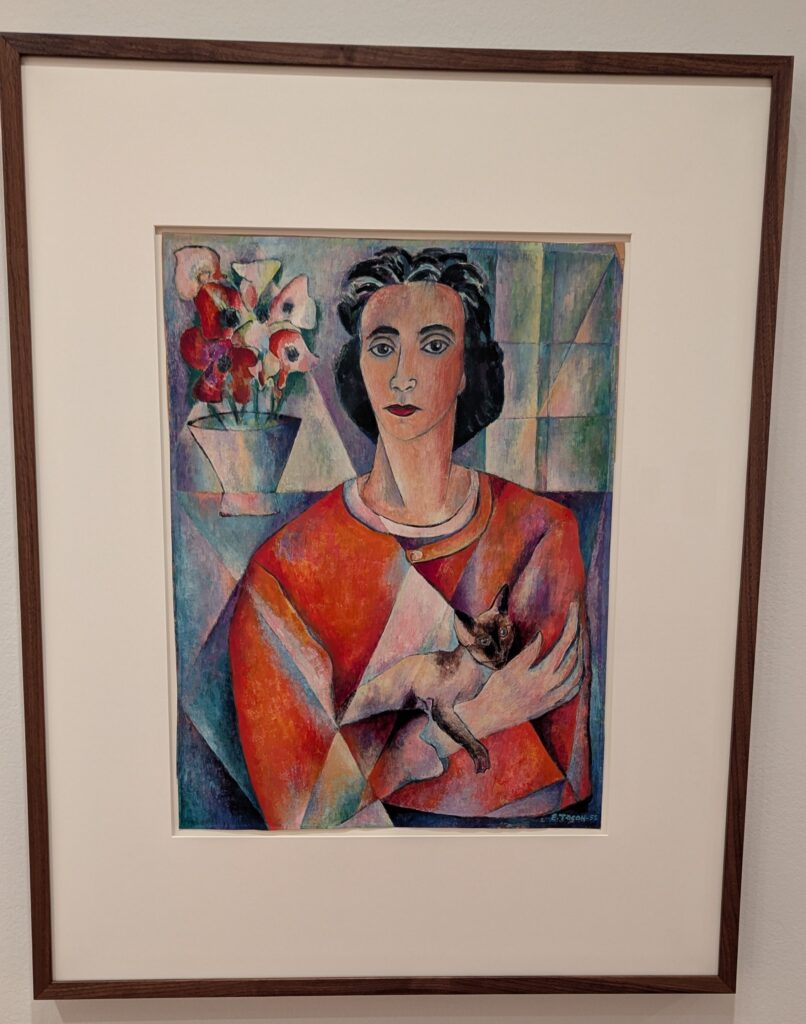
She has a direct and challenging gaze at the viewer, projecting gravitas and confidence. She does not hide her grey hair. The colour palate and flowers in the background evoke her work as an artist. In her arms, she is cradling a cat, which I read as a contrasting expression of playfulness.
I will quote van der Avoird’s conclusion (p. 69). “She translated her musical prowess into non-objective art, where she excelled and led a movement in Canada, forging a path for progressive artists in her wake. All the while, she worked: as a hostess [docent], muralist, educator, milliner, dressmaker, designer, contextualist, mother, and grandmother. She was radical, and she consistently challenged the traditions of art and society.”
I concluded my visit to the AGO, appreciating two excellent exhibits (and then reading van der Avoird’s perceptive portrait of a fascinating life). Both McCartney and Tacon were radical. While his influence was global and hers professional and local, both deserve celebration and contemplation.

Leave a Reply