
I’ve been on radio silence since mid-February because my wife and I were in Paris for two weeks to visit our son who is studying there. My wife hadn’t been to Paris before, and we had long intended to make this trip. I’ve been to Paris quite a few times – I can remember ten, but there were likely more – so I was the planner. Here are some observations on four topics: food, transport, the Jewish presence, and the museums.
Food: An Ongoing Obsession
We rented an apartment and shopped almost daily to prepare breakfast and dinner. Boulangeries still abound and produce wonderful bread and pastries, but there are fewer boucheries, charcuterie shops, and epiceries than in the past, with grocery chains displacing the latter three. High-quality neighbourhood restaurants are plentiful, with wait staff who take pride in their profession, and clients who linger over their meals. We had excellent meals at Le Passy, our local restaurant in the 16th; Le Verre Siffleur, our son’s local restaurant in the 14th; Chez Hanna, a middle eastern restaurant in the traditional Jewish district (rue des Rosiers); the elegant belle epoque style Restaurant at the Musee D’Orsay; and Bouillon Chartier, a famous, immense, and popularly-priced bistro that has been in business since 1896. We ate well.
From Carnet de Dix to Navigo Card
We made several trips on the Metro daily. I was impressed by its continual renewal. Platform barriers have been installed on several lines. The pneumatic whoosh of yellow tickets zipping through the turnstile machines has been superseded by the silent touch of Navigo cards, and used tickets no longer litter the floor. Many of the trains have been replaced, but there are still some older ones where the passenger must open the door, with the satisfying metallic thud of the lever. The trains generally run on time with intervals of no more than 5 minutes and are rarely frequented by people with obvious mental health issues. In short, the Paris Metro continues to set a global standard for large public transit systems.
Saying Kaddish at St-Germain-des-Pres
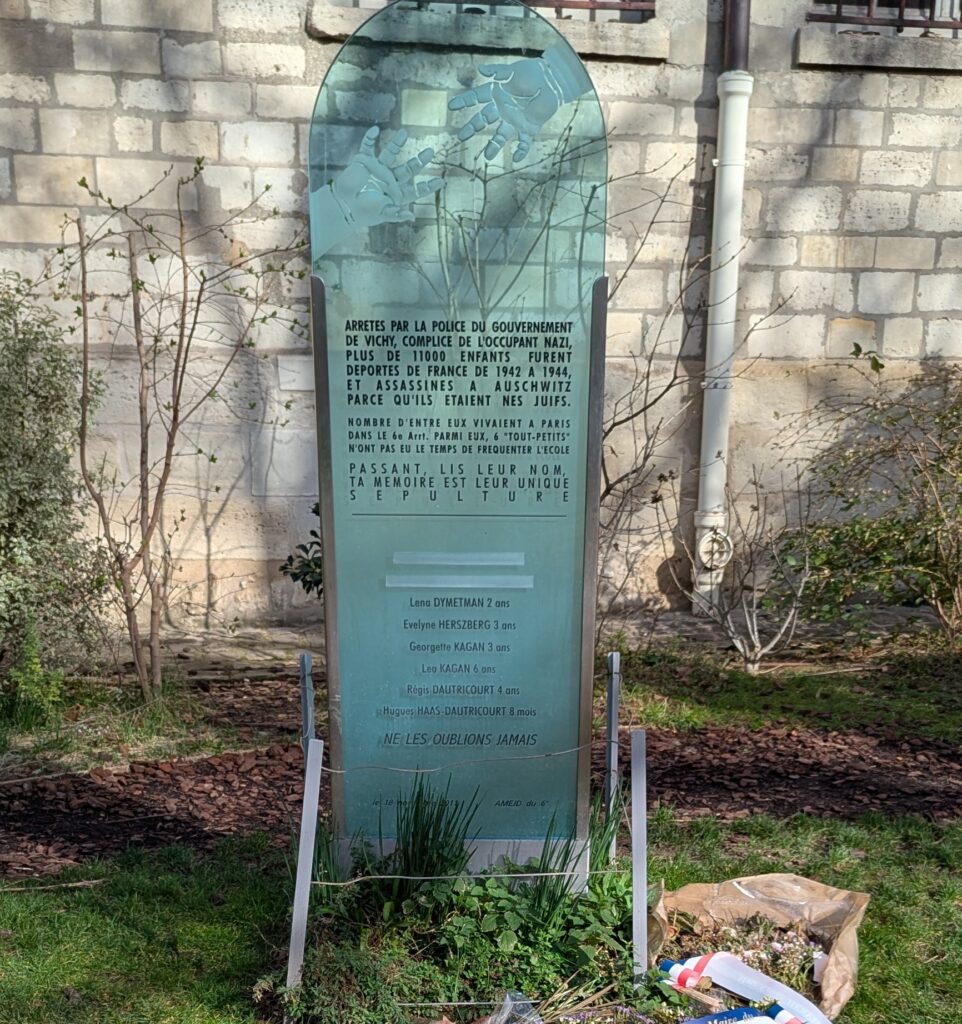
Jews have centuries of history in France, marked by periods of oppression and liberation, and ongoing antisemitism. One of the worst periods was the Vichy Government’s complicity with the Nazis in the round-up and deportation of 75,000 Jews to the concentration camps and death camps. It is remembered by the Memorial to the Martyrs of the Deportation in the shadow of Notre Dame and the monument at the site of the Velodrome D’Hiver (Jewish Martyrs Square) in the shadow of the Eiffel Tower. The Chirac Government placed memorial plaques on schools and public buildings from which Jewish children had been deported. The one we found most moving is in a small park beside the church of St. Germain-des-Pres, which names six preschoolers and states that “your memory is their only burial.” We said Kaddish for them.
Despite this history, there is a lively Jewish presence in Paris. The Museum of Jewish Art and History has an excellent permanent collection that includes Mizrachi Jews of whom we of Ashkenazic background know very little. When we visited, it had special exhibits about the photographer and photojournalist Denise Bellon and about Chaim Kaliski, whose drawings documented Jewish life during the Nazi occupation of Brussels. Our son has reached out to the Jewish community, and we attended shabbat services at Chabad and at a modern Orthodox congregation.
(Personal disclosure: Antisemitic vandals fired shots into the lobby of our congregation in Toronto — Temple Emanu-El — a few nights ago, about an hour after the Purim celebration ended. Antisemitism is a global phenomenon.)
Beauty Despite the Selfies
Visiting Paris’s famous museums can be a challenge, even in February, which is not peak tourist season. For the most popular museums and for special exhibits, it is now essential to book tickets online. And when you arrive at your appointed time, the museum will be very crowded, with many visitors doing nothing more than taking selfies in front of famous works, making it difficult for people with more serious interests to observe and contemplate. But, for those who do want to observe and contemplate, excellent acoustiguides are often available.
In our two weeks, we visited the Louvre, Orsay, Orangerie, Fondation Louis Vuitton, Musee des Arts Decoratifs, Cluny Museum, Museum of the History of Paris (Musee Carnavalet), Maison Eugene Delacroix, Maison Emile Zola and adjacent Dreyfus Museum, and the Pantheon. As the planner, I concluded that given the challenge of booking timed-entry tickets and less-than-boundless energy of senior citizens, it is best to visit one or at most two museums in a day.
Here is a short list of my most memorable visits.
The Crypt at the Pantheon, where only eighty people are interred, forty of whom were chosen by Bonaparte himself. The acoustiguide explains the nature of “Pantheonization” – their word – in which the current President of the Republic chooses people who represent values they want to exemplify. Emmanuel Macron’s choices have included Josephine Baker, politician and feminist Simone Veil, Resistance leader Missak Manouchian, and social historian Marc Bloch, who as a Jew was executed by the Nazis.
The Fondation Louis Vuitton which was entirely given over to a fascinating retrospective on the work of the polymath contemporary German painter Gerhard Richter, which we saw two days before closing.
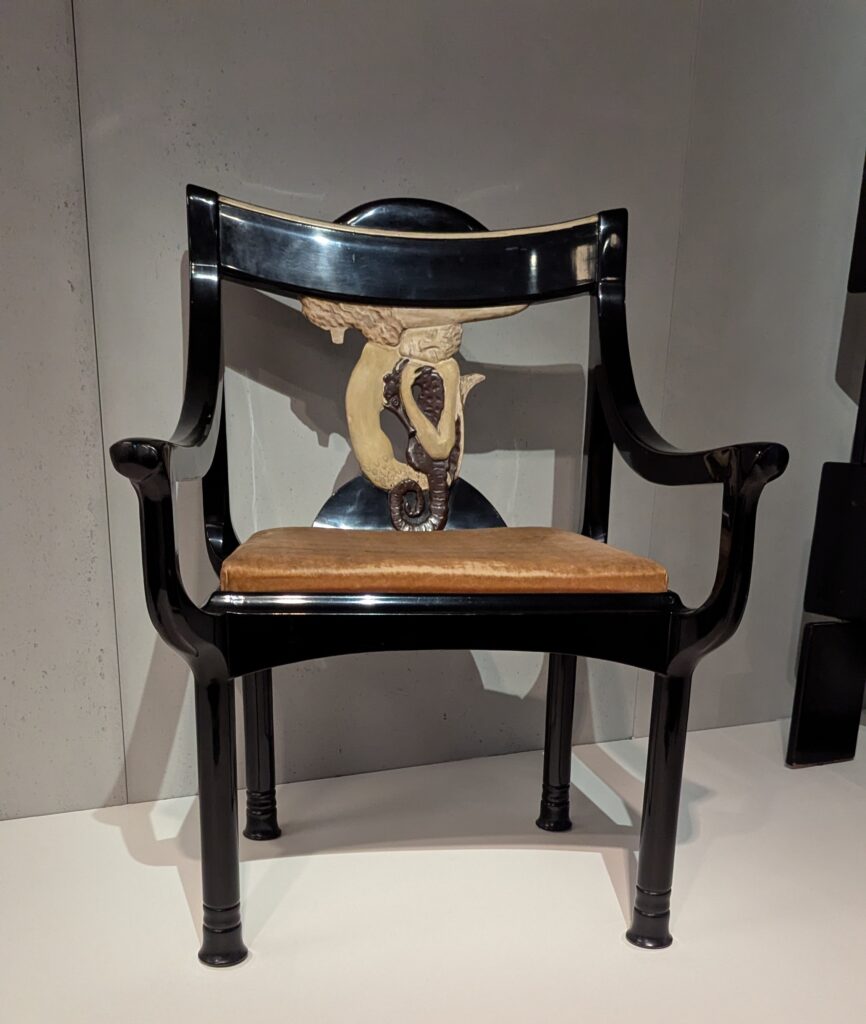
The Musee des Arts Decoratifs has a special exhibit on 100 years of Art Deco, commemorating the 1925 Paris International Exhibition of Modern Decorative and Industrial Arts that was the peak of Art Deco. The exhibit contains painting, furniture, clothing, jewellery, all in Deco style.
In the Orsay, the rooms containing the most famous impressionist paintings on the top floor are the most crowded. Off the beaten track was the pairing of Manet’s Olympia and, right beside it, The Fifer. The acoustiguide explained that, after the former scandalized the public, the more traditional theme of the latter was Manet’s attempt at restoring his reputation.
At the Orangerie, there is a sign at the entry to the rooms containing Monet’s eight huge water-lily canvases reminding us that his intent was that we observe the paintings in contemplative silence. The message was missed by the crowds who scooted through for a quick look and a selfie. I attempted to observe Monet’s injunction and listened to the guide and looked carefully. In addition to the energy and grandeur of the work, what impressed me was that these paintings are the culmination of Monet’s career, executed in his seventies and eighties as his eyesight was failing. It is very rare for someone to do their most creative work at the end of their career, but somehow Monet did.
We had two very rewarding weeks in Paris and only scratched the surface. I look forward to our son’s graduation.
Leave a Reply