
This story begins with my parents, Sidney and Beverley Borins. After operating several small businesses in food and drink (which I discuss in my eulogy for my mother), they made a radical change and in 1971 opened an art boutique. Up the Wall began by selling the weavings, macrame, fibre art, and fabrics that had become popular alternatives to prints and paintings.
To house it, they bought a four-storey Georgian revival style warehouse built in 1840 that unfortunately showed its age. At 33 Jarvis Street, it was in a neighbourhood, anchored by St. Lawrence Hall and the St. Lawrence Market, that was gentrifying.
Focusing on Canadian Art
The wave of nationalism that followed Expo 67 and the Centennial was expressed in the art world by artists like the polymath Joyce Wieland (the subject of a retrospective on now at the AGO), the political and cultural satirist Charles Pachter, and the Anishnabe shaman Norval Morisseau. Beverley, the lead partner in Up The Wall, soon turned to indigenous work, including the Woodland School of Anishnabe Art and Inuit prints and sculpture. Fascinated by ability of Inuit artists to interpret the beauty and adversity of their environment and their way of life, she began making buying trips to Arctic settlements like Cape Dorset (now Kinngait) and Frobisher Bay (now Iqaluit). Up The Wall thus evolved from a boutique to a gallery.
By their sixties, my parents tired of the daily grind of running a business and in 1984 they sold their store. But my mother kept the business going out of their empty-nest suburban home, continuing to make summer trips to the Arctic and buying and selling Inuit sculpture. She particularly liked sculptures in white quartzite from Kinngait. Quartzite is harder to work with than softer soapstone, and the vein of quartzite there was depleting, so these sculptures were becoming very valuable. Eventually Beverley was buying considerably more than she was selling, so she became a collector.
My siblings, Irene Borins Ash and Michael Borins, and I began to think about what we wanted to do with the sculptures that would ultimately become part of our inheritance. I collected art eclectically, with interests in art glass, Japanese prints, and certain Canadian prints (including one Pachter and two Morisseaus) and paintings. (Three summers ago, all my blog posts were about my art collection; a final post draws conclusions about the process and there are earlier posts about individual artists.) I have a few large Inuit sculptures my mother gave me, but I feel that to do them justice they need to be surrounded by considerable open space.
The First Two Major Gifts
In 1995, the Rotman School of Management, where I had an appointment, was opening a new building with a large atrium. The development committee, led by Dean Hugh Arnold, was looking for art works that would complement the atrium. I put Hugh in touch with my mother. The committee was enthusiastic about my mother’s sculptures, especially the large quartzite pieces from Kinngait. As a family, we agreed to donate 24. We were extremely gratified about this donation for several reasons: the large public setting that provided an ideal place to display these sculptures, the recognition from the School and my colleagues, and the tax credit. The sculptures remain on display in what is now the north wing of the Rotman School (105 St. George St.) especially in the foyer outside the Dean’s Office on the third floor and the library on the second floor. I encourage readers to stop by and see them.
In 2010, my mother made a larger and more diverse donation of sculptures including large quartzites and small ivories, textiles, prints, and books to the Macdonald Stewart Art Centre at the University of Guelph (now the Art Gallery of Guelph), which I discussed in a post at the time. Beverley was adept at needlecrafts and had made an amautiq – a woman’s parka with a large hood for carrying an infant – with 2000 beads sewn on heavy wool, and this too was part of the donation.
The AGO Donation
Even after the major donations to the Rotman School and Art Gallery of Guelph, my mother had a sizeable collection of Inuit sculpture that occupied many corners of her 1500 square foot condo, including counters and shelves in her living room and a row of large white quartzite sculptures in her bedroom. After our sister Irene had taken all the sculptures she wanted, my brother Michael and I divided up the 46 sculptures that remained. In 2018, Beverley gave each of us a gift of the sculptures we preferred, with the proviso that they stay in her apartment for the rest of her life.
As my mother was reaching the end of her life, I began to look for an appropriate recipient for a donation of the sculptures she had given me. I approached Taqraliq Partridge, then curator of Inuit Art at the AGO. Taqralik visited my mother in her apartment. My mother, in her wheelchair, was wearing an Inuit-style vest she had sewn. Taqralik said the sculptures reminded her of home and she and my mother shared their experiences as beadworkers. Afterwords, Taqraliq told me Beverley’s life force was very strong: but it was the last professional engagement of my mother’s life.
After Taqraliq’s recommendation for the AGO to acquire my 23 pieces, there followed two years of bureaucratic processes including the acquisition committee decision, packing and shipment, appraisal, formal transfer of the work, and certification of several pieces by the federal government’s Canadian Cultural Property Export Review Board. I want to mark the completion of this process with this post. In addition to Taqraliq Partridge, I deeply appreciate the assistance of curator Renee van der Avoird, art scholar Vanessa Nicholas, and curatorial assistants Emily Henderson, Chloe Wittes, and Jessie Snow.
I will conclude with photos of two of my favourite pieces in my donation. Kaka Ashoona (1928-1996) was a well-known Kinngait carver, and son of the world-famous artist Pitseolak Ashoona. His Arctic Hare is an unusual subject. The sculpture is 20 inches high, and I like its rounded shape as it tapers down from head and ears, to front paws, and then rear paws.

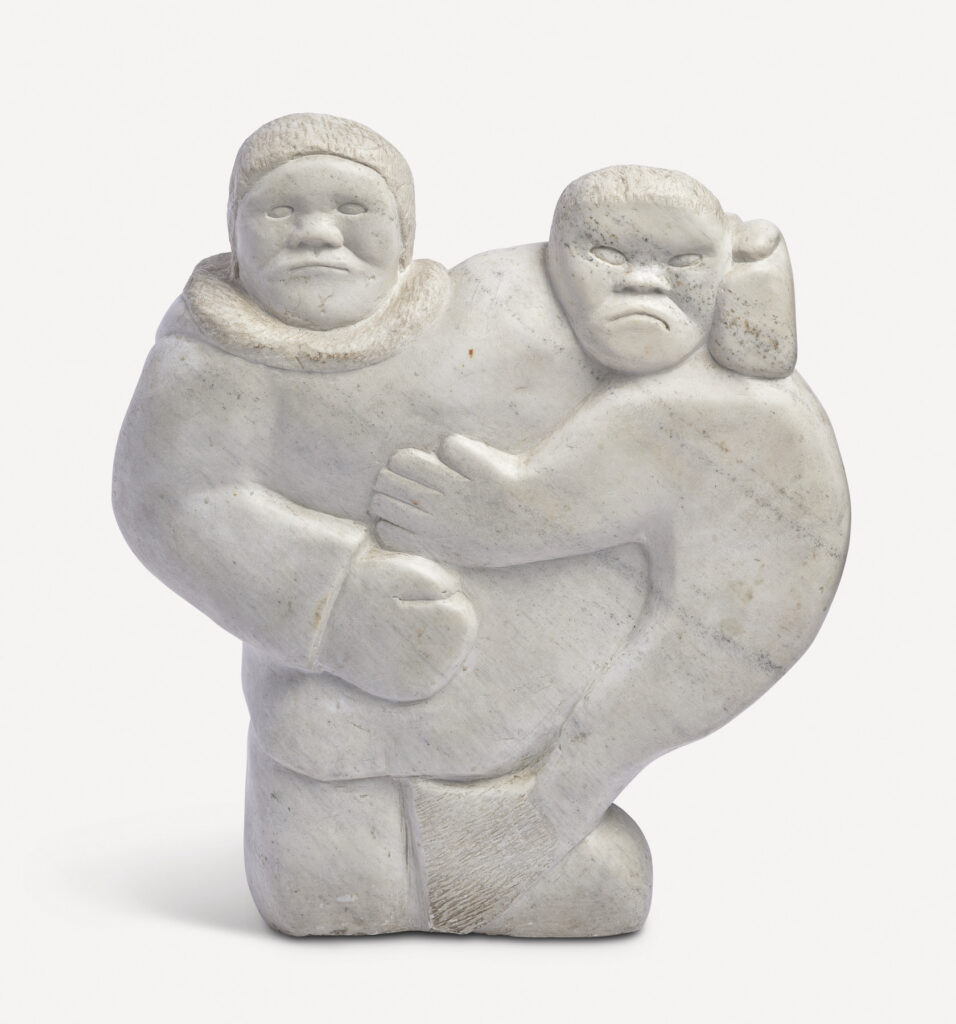
Axanguyak Shaa (1937-2019) was another major carver at Kinngait, well-known for his carvings of dancing animals. This sculpture, which stands at 22 inches, appeals to me because of the symmetry and proximity of father and son and the heart shape of the stone. The son’s torso appears to become a seal’s flipper, representing a transition to, or kinship with, the animal world.
Now that the pieces I have donated to the AGO are finally in its possession, I hope many will be displayed soon. The AGO will open a great deal of new gallery space in 2027, and this should lead to the display of more Inuit art, especially shows about individual artists.
I am pleased and proud to be able to share the results of my mother’s obsession with Inuit art more widely, both in a building in which it is a surprise to see works of art, and in a building devoted to the display of works of art. My mother would have been delighted.


Leave a Reply