
I just attended convocation for my home department, University of Toronto Scarborough (UTSC) Management. I was wondering how the University of Toronto’s ongoing encampment and the elevation of the Palestinians to a cause celebre in some parts of academe would affect our convocation.
Rather than simply using the front entrance to Convocation Hall on King’s College Circle as in the past, everyone attending must check in and pass through security at a side entrance. Once security is enhanced, it will never be relaxed.
OccupyforPalestine has colonized the fence steps from the front entrance to Convocation Hall to place some of its most offensive posters, such as the one below, so changing the access and entry point allows participants to avoid them.
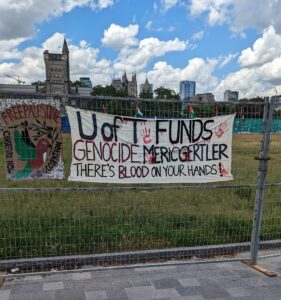
I was on stage in the front row at the side. The pandemic has eliminated kneeling, handshakes, and the handing out of diplomas, greatly speeding up the ceremony. Students enter the stage from the back and, when their name is called, come forward and then cross the stage. How do students present themselves in their five seconds in the limelight? Some are triumphant and wave at family and classmates in the audience. Others appear relieved. Some express gratitude and at least a few turn and pay their respects to the officers of the university (chancellor, president, provost) and of our faculty who are sitting in the front row at the centre of the stage.
I was wondering how many students would use their fleeting seconds on centre stage to show their support for the Palestinian cause by wearing a kafiya or making some gesture of solidarity.
My Observational Findings
As my title suggests, at this convocation relatively few did. Counting names in the program, 267 UTSC Management students and 216 UTSC Arts and Sciences students graduated; approximately two-thirds were present. In the Management group, four students wore kafiyas; in the Arts and Sciences group, eleven. Given my uncertainty about the numbers present, I would say that fewer than 5 percent of the Management students and between 5 and 10 percent of the Arts and Sciences wore kafiyas. Of the 15 students who wore kafiyas, only two used them in gestures of solidarity. Finally, no one disrupted the ceremony.
Discussion
Many commentators in the US have noted that encampments and other expressions of support for the Palestinian cause are strongest at elite universities, less so at state universities and colleges, and much less so at institutions whose students are the least privileged. And they have also applied the long-standing finding that arts and sciences students are more leftist than management students to hypothesize that the former would be more supportive of the Palestinian cause than the latter.
Students at UTSC are among the least privileged at U of T, with very high percentages who are immigrants or first-generation Canadians, the first generation in their family to attend university, or visible minorities, or all of the above. The observation that less privileged students are less supportive of the Palestinians than students of wealthier backgrounds seems to apply in this case, as would the hypothesis that management students are less supportive than arts and sciences students. Academic colleagues I chatted with observed that convocation is an immensely moving ceremony for new Canadian parents and that their children making a political statement would disrupt parental enjoyment.
While I do not question the right of students to wear kafiyas or make gestures of solidarity, I was pleased to see that support for the Palestinians does not appear to be universal within this large and diverse university.
Expressing my Jewish Identity
I decided to wear a kippah in place of my normal mortar board. A minuscule proportion of UTSC’s students and a decreasing proportion of its faculty are Jewish. I may have been the only Jewish person in Convocation Hall that morning. While I do not normally wear a kippah, wearing one on this occasion was my way of saying that Jews are a part of the University of Toronto and will continue to be a part of it.
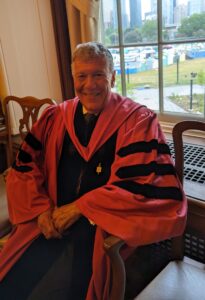
I asked a colleague to take a photo of me in the Council Chamber of Simcoe Hall after Convocation. It tells a complex story. In the foreground, the Phi Beta Kappa key on my academic robes expresses the value I place on academic excellence. In the middle ground, the kippah signals my Jewish identity. In the background you can glimpse the encampment, so close to Simcoe Hall, the university’s administrative centre, and Convocation Hall, its ceremonial centre. Sooner or later, hopefully sooner, the encampment will leave. But warm and strong ties between the University of Toronto and Jews, Israelis, Zionists, and Israel will remain.
Leave a Reply