
As we age, we spend more time looking back, tallying up the deeds and relationships that gave us satisfaction and those that we regret. Concern about our appearance leads us to choose our clothing and arrange our features in ways that mask the effects of time on our bodies. (Personal disclosure: I’m 77, so I’m speaking from lived experience.)
The interplay of self-scrutiny and self-presentation is essential to what will emerge when we are being photographed. The photographer Richard Avedon was deeply aware of this in his photographs of elderly people, many of whom had achieved recognition, if not renown.
A superb exhibit of Avedon’s photos of the elderly, Immortal, is now on display at The Image Centre at Toronto Metropolitan University. The excellent catalogue includes commentary by those who knew Avedon well. The writer Adam Gopnik recounts that for Avedon, beyond technique, “everything else was about the confrontation and conversation of two people, the photographer and the sitter.” Paul Roth, Director of The Image Centre and curator of the exhibit, reports that Avedon believed that “in a portrait the face could symbolically express the entirety of a person’s effort and struggle in life: our aspirations at the beginning and the fears and failures that limit us; the challenges we overcome, and those that overwhelm us.”
Reading the Faces
Many of the 100 photos in the exhibit are iconic, some to the point that Avedon’s is the image that comes to mind when we think of the subject (Samuel Beckett, Stephen Sondheim). Many are also discussed in the newly released Netflix documentary Avedon. Avedon’s photos of subjects suffering from substance abuse (Chet Baker, Dorothy Parker, Oscar Levant) and subjects who had poisoned their lives through hatred and bigotry (Ezra Pound, George Wallace, the Duke and Duchess of Windsor) are undoubtedly powerful, but my strong feelings of either sympathy or disdain outweigh my admiration for Avedon’s aesthetic achievement. I was attracted to photos that left me with the impression that their subjects’ lives were well-lived: the Dalai Lama’s grace and serenity, Duke Ellington’s understandable pride standing in front of the Apollo Theatre with his name on the marquee, and the novelist Marguerite Duras’s youthful smile.
As a scholar of government, I was drawn to those who had lives of public service. Photographed three years after leaving office Dwight Eisenhower projects focus and intelligence. In 1993, Avedon did portraits of the “Camelot group,” people who had served in the Kennedy administration thirty years before.
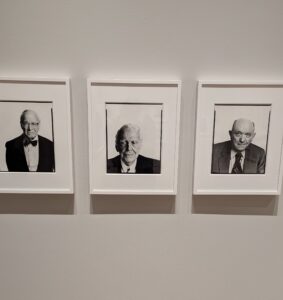
The three displayed in the exhibit have expressions that suggest ongoing sadness about the tragic end of the administration. The historian Arthur Schlesinger (left), a special assistant, has a half-smile that might also be read as a grimace. Legal counsel Clark Clifford (centre) looks wistfully away from the camera. Former Secretary of State Dean Rusk (right) appears to be interrogating the viewer.
A fourth person photographed in this group, but whose photo was not displayed at the exhibit was historian of the presidency Richard Neustadt. (Personal disclosure: Neustadt was one of my professors at the Kennedy School at Harvard and a mentor, which puts me one degree of separation from Avedon.) Neustadt did not serve in Kennedy’s White House, though he did in Truman’s. Kennedy was influenced by Neustadt’s book Presidential Power. Neustadt advised Kennedy on the transition and continued to serve as an adviser and confidant throughout his presidency. Neustadt’s daughter Beth liked the Avedon photo so much she chose it for the cover of her edited volume Guardian of the Presidency: The Legacy of Richard Neustadt.
In the photo Neustadt, then in his early seventies, strikes me as at ease in his skin, frank, congenial, and not too serious. Neustadt also seems to stand apart from the collective heaviness of the group. Judging by the photo, what Gopnik calls the confrontation and conversation between Avedon and Neustadt was amiable rather than troubling.
A Different Approach
A year ago, I wrote a post about the portrait photographer Yousuf Karsh (whom I had once interviewed), discussing Melissa Rombout’s newly published retrospective. Seeing the Avedon exhibit, I wondered what he thought of Karsh. I wasn’t surprised Gopnik wrote that Avedon “hated the kind of portraiture that simply ennobled its sitters. He was, shall we say, catholic and courageous in this dismissal, landing on Rembrandt’s self-pitying self-portraits, as he perceived them, as harshly as he did on Karsh of Ottawa’s attitudinizing.” In an interview in the Christian Science Monitor in 1993, Karsh recognized that his approach was different than Avedon’s but made no apologies. His mission was to photograph great people – many of whom commissioned his portraits – and arranged the lighting, setting, and ultimately the image to communicate exceptionality. Some of his portraits (Churchill, Oppenheimer) are as iconic as Avedon’s.
While writing this post, I remembered that my late sister, Irene Borins Ash z”l”, photographed accomplished elderly people. The title of her book Treasured Legacies: Older and Still Great, makes it clear that she worked in Karsh’s tradition. For her, photography was a quest to learn from her subjects, some of whom were accomplished, others local heroes, and a few (Oscar Peterson) renowned. I’m glad to honour her memory here.
The Paradox
The Avedon exhibit ends very soon (December 5), and I strongly encourage readers to see it. The catalogue will remain available, as will the Netflix documentary, and they are both excellent substitutes for the exhibit. To end with Avedon’s title: celebrity photography can be seen as an attempt by both the photographer and sitter to grasp at immortality, even when the photograph is a depiction, sometimes unsparing, of the sitter’s mortality.
Leave a Reply