
With the publication of Public Representations earlier this year, my half-century as a researcher is finished. I intend to write a memoir to impart some lessons for those starting or even part-way through their research careers. I don’t expect to write much until I finish teaching this semester, but I will use this post to share some of my preliminary thoughts.
Lines of Research
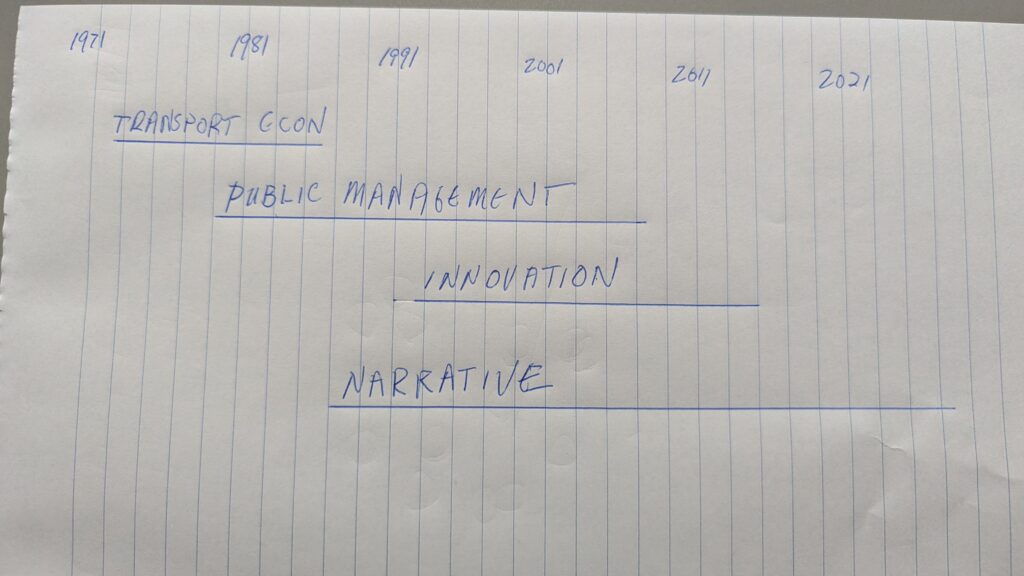
I received my undergraduate degree in 1971, completed my Ph.D. in 1976, and my last major publication was in 2026. My name is on the title page of 12 books and 80 journal articles or book chapters. I’ve worked in four major areas: transportation economics, public management, public sector management (which can be considered a subfield of public management), and management and narrative. I’ve come up with a graphic to represent what are, literally, four lines of research. Time is on the horizontal axis, and the lines of research are presented chronologically, with the earliest line on the top. In a more detailed version of this there will be points on each line to represent major publications. And if you look vertically, you can see which lines I was working on at any given time. At some points in my career I was working in several areas simultaneously. Here is the graphic:
Hedgehog or Fox?
In a famous essay, Isaiah Berlin distinguishes between the fox, who knows many things, and the hedgehog, who knows one big thing. Clearly, I was a fox. I want to discuss why I chose that approach, and its advantages and disadvantages for me relative to the other approach.
Other People Involved
Looking more closely at my publications, it becomes clear that at the outset I was trying to emulate, or at least was inspired by, the work of some of my graduate instructors. Over time, collaborators became more important, both as research assistants and co-authors.
Eureka Moments and Turning Points
Research is a process of discovery, so there should be many Eureka moments in a research career. Some, but not all, of these moments become turning points, leading to new approaches and new lines of research. I observed about a half-dozen Eureka moments that also became turning points. Here are a few, with the details to be filled in later:
- Finding an error in a journal article I referred to in my doctoral dissertation led me to a new line of research in transportation economics.
- Confirming through an interview with its co-author that a comedy series exploited a theory in political economy led me to a line of research on management and narrative.
- Not being appointed to a chair was the impetus for a burst of productivity, a body of 8 articles in 3 years.
Explaining My Google Scholar Count
I will consider my Google scholar count in terms of factors like the availability of the Internet at the time of publication and the strength of my links to various academic communities. It turns out that my pattern exemplifies the Pareto (80-20) rule.
Books, Articles, and Other Products
In the last 50 years, scholars in many fields have stopped writing books and focused on articles for academic journals, preferably top-tier. Maybe I should have written more articles and fewer books. But the impact of a line of research on both scholars and practitioners might depend on a variety of forms, such as books, top-tier articles, practitioner-oriented articles, reports, and presentations. In one area, this is what I produced.
Hotel California Syndrome
For better or worse, my work in transportation economics displays the Hotel California syndrome: “you can check out any time you like, but you can never leave.” I stopped doing research in transportation economics in 1985. Since then, I served on the Board of the Crown corporation that built Highway 407 and eventually wrote a book on the experience. Drawing upon my dissertation research, I’ve been involved in trying to stop the Ontario Government from expanding Billy Bishop Airport.
Regrets, I have a Few
I know I have some regrets about my research, and prolonged contemplation may lead to more. Here are three:
- I stopped doing transportation economics at a point where I could have taken that line of research into what I think would have been pathbreaking work in applied welfare economics.
- I led a research project about public sector information technology. It culminated in a book that we published in 2006, in which we said nothing about social media.
- I was a strong advocate for new public management because it was injecting private sector approaches into public management. Now we are seeing the capture of many governments, most notably that of the US, by thoroughly corrupt businesspeople. That isn’t the type of private sector approach I had contemplated.
I’m sure I will have much to consider and to write about. I look forward to starting.
Leave a Reply