
Queen’s Park has been on my mind for the last few days due to an event I attended there last Thursday night and a policy made there a few weeks ago. First, the event. I received an invitation from Stephanie Bowman, the MPP who represents me in Don Valley West, to a Hanukah party at Queen’s Park. I was wondering who would be giving the party and who else was invited.
The Liberal Caucus Celebrates Hanukah
It turns out this party was given by the Liberal caucus, and the MPPs invited a small number of constituents and community leaders, in particular rabbis in constituencies they represent. The party was held in the Speaker’s boardroom, which accommodates 100 people, so the guest list was limited.
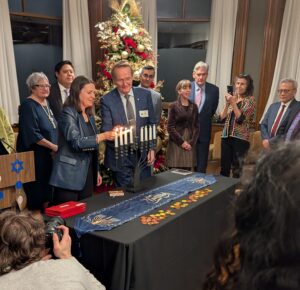
None of the Liberal MPPs are Jewish (as is the case with the NDP. Four PC Party MPPs – Michael Kerzner, Andrea Khanjian, Laura Smith, and Michelle Cooper – are Jewish). The reception was an attempt by the Liberal caucus to reach out to the Jewish community. It included candle lighting, latkes and sufganiyot, songs, and remarks by Stephanie Smyth, MPP for Toronto-St. Paul’s, and Rabbi Yael Splansky of Holy Blossom Temple, also located in Toronto-St. Paul’s. At a time when antisemitic incidents have dramatically increased and the Jewish community feels besieged, this was a welcome outreach initiative. In her remarks, Rabbi Splansky discussed the historical significance of Hanukah and its contemporary relevance. My wife and I appreciated the invitation and were moved by the event. For the record, here is a photo of Stephanie Bowman lighting the hanukkiah, along with Pekka Sinervo, who, like me, lives in Don Valley West, is a member of Temple Emanu-el, and is on the faculty at the University of Toronto.
The Ford Government Repeals Toronto’s Green Roof Bylaw
Now, I turn to policy. The Ford Government, which as a provincial government has the power to legislate for and about municipalities, repealed Toronto’s 2009 bylaw requiring green roofs on structures with a gross floor area of over 2000 square metres. The repeal was a provision of the Fighting Delays, Building Faster Act of 2025, but the Government pre-empted its own legislation with an order-in-council under the City of Toronto Act, signed by the Lieutenant Governor on October 23. In justifying this decision, the Government often prefaced the term “green roofs” with the adjective “so-called” and condemned green roofs as a “boutique program” “unnecessary regulatory burden,” and an “unnecessary cost.” It also noted that no other Ontario jurisdiction has a green roof program, so the repeal is “cutting red tape for builders by making Toronto’s rules consistent with the rest of the province.”
The City criticized the decision, arguing that green roofs reduce the flow of stormwater, ambient heat, energy consumption, and greenhouse gas emissions. But the senior jurisdiction had the last word.
I have four observations about what this decision reveals (or, more accurately, confirms) about the Ford Government’s decisions and decision-making.
First, short-term and readily measurable private costs (construction) matter more than longer-term, harder-to-measure social costs, such as processing stormwater or greenhouse gas emissions. Not only do the former matter more to the Ford Government, but it did not attempt to do any policy analysis to compare private and social costs and benefits using the same yardstick.
Second, the Ford Government embraces standardization and stifles and punishes innovation. Toronto is the largest city in Ontario and has a larger problem of human-generated heat than the others. Why shouldn’t it be able to enact a policy that protects its urban environment? Toronto was the first city in the world to implement a green roof program and its initiative has been widely replicated. The Government doesn’t care.
Third, the decision was implemented as stealthily as possible. Stakeholders, especially likely opponents such as the City of Toronto and environmentalists, were not consulted. No hearings were held. The repeal was not debated and voted on by the Legislature; it was simply done as an executive order under an existing act. And the order-in-council was signed when the main focus of public attention was … the World Series.
My fourth point is a conjecture. Land developers have been strong supporters of the Ford Government and the Ford Government has deferred to them, for example in rezoning parts of the Greenbelt. I would not be surprised if developers were complaining to Premier Ford about “so-called green roofs” and he listened to their complaints. Their donations, under the newly increased donation limits, might have helped seal the deal.
Though Doug Ford attacks Trump on tariffs, he governs as a fanboy, with his rejection of environmental protection and climate change mediation, his disdain for policy analysis, his circumvention of a robust democratic process through executive orders, and his kowtowing to business interests.
In my view, these two stories represent the good, the bad, and the ugly of politics. A good initiative to reach out to a besieged community. And a bad policy decision, implemented through an ugly process.
Leave a Reply